×


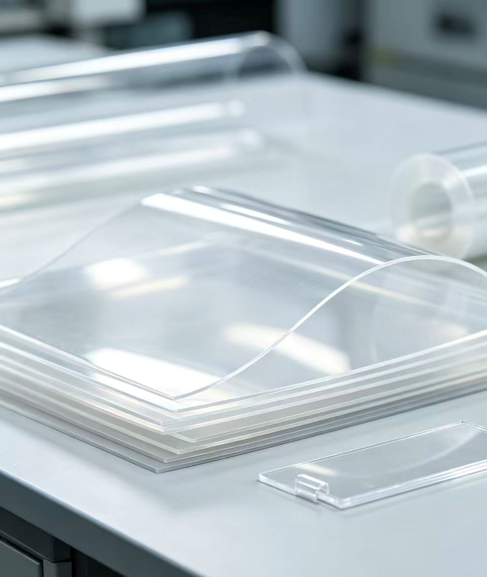
Transparent single – layer plastic sheets made of PET, PP, and PS are widely used in food vacuum packaging, disposable tableware, and industrial linings. Downstream customers have extremely high requirements for the transparency and color consistency of the sheets. Even a slight yellowing can lead to the return and scrapping of the entire batch of products.
Many factories are equipped with single – layer sheet extrusion production lines. They keep adjusting parameters like drying temperature and barrel temperature, but the problem of sheet discoloration still occurs frequently.
In fact, most people overlook a key issue: the plastic melt stays in the equipment for too long. When the melt is in a high – temperature environment for a long time, thermal oxidation and molecular chain breakage gradually occur, producing yellowing and degrading impurities, which are finally reflected in the finished sheets. This article elaborates on the principle of sheet yellowing caused by the long melt residence time, shares practical methods to shorten the melt residence time in single – layer sheet production, and proposes solutions to the problems of sheet discoloration and yellowing. It helps factories stabilize the product appearance, reduce the scrap rate, and enables the entire extrusion production line to continuously produce qualified sheets with uniform gloss and no color difference.
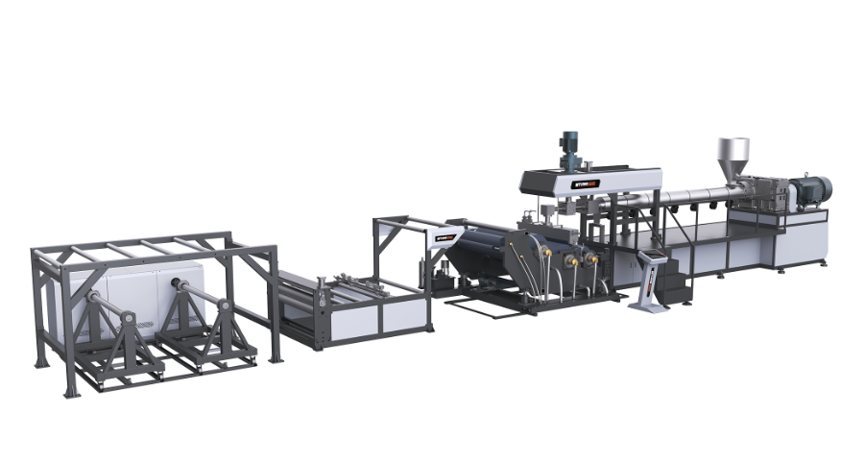
To completely solve the yellowing problem, we first need to understand: why does the melt change color when it stays at high temperatures for a long time? And in traditional single – layer extrusion equipment, where are the dead spots where materials tend to accumulate?
Heat – sensitive plastics like PET can’t tolerate high temperatures for a long time. Besides the temperature level, the length of high – temperature exposure is the key factor causing material degradation and discoloration. This is mainly caused by the following two reactions:
The first is thermal oxidation degradation: When the melt contacts the residual trace amount of air at high temperatures, the plastic molecules decompose, producing impurities that cause discoloration, making the originally transparent sheet gradually turn yellow and dark.
The second is the hydrolysis reaction: The trace amount of residual moisture in the raw materials will accelerate the breakage of the plastic molecular chain. Especially when using recycled materials for single – layer extrusion production, the problems of yellowing and discoloration are more obvious. Even if the equipment temperature is set exactly according to the standard, as long as the melt stays in the machine for more than 90 seconds, the finished product will have defects such as high haze and yellow stripes. Therefore, precisely controlling the melt residence time is the best anti – yellowing method to achieve the best results at the lowest cost without affecting production capacity.
The material dead spots inside the equipment are the main sources of melt accumulation, long – term retention, continuous degradation, and yellowing. For ordinary single – layer sheet extrusion equipment, there are mainly four areas where material accumulation is most likely to occur.
| Stagnant Position | Formation Reason | Yellow Defect Feature |
| Screw barrel clearance | Worn screw flights create narrow gaps for slow-moving melt | Random scattered yellow specks across sheet width |
| Die manifold sharp corners | Right-angle flow channels trap stagnant polymer | Long vertical yellow stripes on finished sheets |
| Screen pack blind cavities | Uneven filter stacking leaves low-flow dead space | Irregular yellow patches in batches |
| Transition elbows before calender | Narrow bent pipelines slow melt flow | Edge yellowing on wide-format sheets |
To solve the problem of film yellowing, you can optimize it from two main aspects. One is to adjust the process parameters in real-time during production to quickly control the melt residence time. The other is to upgrade the hardware structure of the extruder for long-term stable production.
Without changing the device structure, you can effectively shorten the melt residence time inside the device just by adjusting the on-site process.
First, match the feeding amount and screw rotation speed properly to keep the material filling rate in the barrel between 60% and 70%. If the material is packed too tightly, it’s easy to form a material retention layer on the inner wall of the barrel. Long-time high-temperature baking will make it turn yellow and carbonize. Second, install a precision gear pump between the extruder and the mold to separate the plasticizing process and the quantitative discharging process of the material. This is the most fundamental way to improve the melt retention rate and can directly reduce the melt retention time by 20% to 30%. Third, try to avoid frequent start – stop of the device. When the machine is idling or running without load, the material will stay in the high – temperature barrel for a long time. Even a short stop can make the material gradually deteriorate and change color. Fourth, combine with an online continuous filter replacement device to reduce the downtime for manual filter replacement, avoid the accumulation of materials under high temperature, and thus prevent the material from turning yellow.
To achieve long – term stable production of high – quality transparent sheets, you must optimize the device structure. You can either use new devices or retrofit old ones.
Replace the ordinary general – purpose screw with a baffle – type screw with a better short – diameter ratio to shorten the material conveying path in the barrel and reduce the material’s residence time under high temperature.
Modify the internal flow channel of the mold. Change all the right – angle structures to smooth arc transitions to completely eliminate the dead corners that easily cause material accumulation and retention. Replace a large number of elbows with large – diameter straight pipes to simplify the connecting pipeline from the extruder to the calender roll, thereby reducing the melt flow dead zones and conveying time.
Upgrade the forced uniform feeding structure to ensure stable and uniform material discharge, avoid sudden changes in material flow rate, and prevent unstable melt flow, local blockage, and performance deterioration.
If you follow these standards in daily production, you can ensure the sheet material is as transparent as possible and has no color difference.
First, the temperature shouldn’t be high all the time during the whole process. Instead, implement gradient cooling from the feeding section to the die orifice to prevent the material from being over – heated and degraded. Second, start the multi – stage high – vacuum exhaust system to timely discharge the volatile impurities generated by the material at high temperature, prevent the impurities from mixing with the molten material and circulating, and avoid yellowing and fogging of the sheet. Third, clean the device every 8 to 12 hours to completely remove the carbon deposits and residues in the screw, filter, and mold channels. Fourth, precisely control the proportion of recycled materials added to ensure it doesn’t exceed 15%. Recycled materials have poor heat resistance and are more likely to degrade and turn yellow than new materials under the same residence time.
If the residence time has already been optimized but the film is still a bit yellow, you can use the following targeted methods to completely solve this problem, okay?
Add some suitable heat stabilizers to the raw materials to prevent the plastic molecules from oxidizing and changing color during the high – temperature production process.
Strictly control the drying process and keep the water content of the PET raw materials below 0.02% to avoid the material turning yellow due to hydrolysis caused by moisture.
Make sure the temperature on both sides of the polishing roller is uniform. Don’t let the temperature difference be too large. Otherwise, the degraded impurities will be trapped in the film, which will cause color difference and yellow stripes.
Make the gear pump and the traction equipment achieve closed – loop linkage control to stabilize the melt discharge pressure and flow rate, and eliminate the local blockage and discoloration problems caused by periodic flow rate fluctuations.
Just making temporary parameter adjustments ain’t enough if you wanna keep the melt residue rate of sheet products at a low level in the long run and avoid yellowing defects. The key is to carry out standardized daily operation and maintenance management and develop stable production habits:
Use the online melt viscosity sensor to monitor the melt residue status in real – time every shift, and set up abnormal warnings in advance. Once the melt residue time exceeds the limit, the equipment’ll automatically sound an alarm to prevent a large number of sub – standard products from being produced.
Check the equipment monthly. Focus on the screw clearance, the smoothness of the mold channel, and the wear of the conveying pipeline. This way, you can spot the expansion of the accumulation area and the aging of components early, and prevent potential yellowing hazards in advance.
Before shutting down the machine each time, make sure to thoroughly clean the equipment with a special cleaning agent to remove the carbide residue in the barrel and the mold. This can stop the residual substances from causing the sheet to turn yellow when you start the machine next time.
Ensure the correct separation of materials during production. Don’t mix transparent sheets with dark – colored modified materials. If dark – colored waste remains in the equipment and gets mixed into the production of transparent materials, it’ll cause yellow spots and random defects.
How long can the melt stay safely during the production of transparent single – layer PET sheets?
At the standard processing temperature, the melt shouldn’t stay in the system for more than 120 seconds. Once it exceeds this time limit, the material will undergo thermal degradation, resulting in obvious yellow smoke and yellow stripes on the sheet. The most reliable way now is to combine the gear pump with a short – runner mold to precisely control the melt’s residence time.
Can adjusting the screw speed alone completely solve the melt retention problem?
Just increasing the screw speed can only slightly shorten the single – cycle time of the material, but it can’t solve the problem of the fixed accumulation area of the material in the mold and the barrel. If you want to achieve long – term and stable production of high – transparency sheets, optimizing the equipment structure is a must. If you need customized solutions for the screw and the runner to completely solve the problems of melt retention and yellowing of the sheet, WYLONG can provide a full – set of equipment optimization services for the single – layer sheet production line.
Will shortening the melt residence time affect the plasticizing effect of the sheet?
Nah. As long as you use a suitable baffle – type screw and a gear pump, you can shorten the residence time while ensuring uniform plasticization of the melt. A reasonable shear ratio can not only ensure full mixing of the materials but also prevent yellowing caused by high – temperature degradation. You can balance both aspects.
This article fully explains the internal principle between long – term melt retention and sheet discoloration, and carefully analyzes the distribution of stagnant zones inside single – layer extrusion equipment. Meanwhile, it puts forward two core optimization plans: adjusting daily process parameters in real – time and continuously upgrading the hardware structure of the equipment. The article systematically outlines a complete set of practical methods to improve sheet discoloration and control melt retention time.
Whether you’re setting up a new transparent sheet production line or renovating old extrusion equipment, strictly controlling the melt residence time is the most cost – effective and efficient solution to prevent yellowing. This whole optimization concept not only ensures full plasticization and mixing of materials but also effectively avoids thermal degradation problems. It’s totally applicable to the production of various high – end single – layer sheets like food – grade PET, daily – use PP, and medical transparent sheets. By following the standardized control process, you can directly reduce yellowing and waste loss by 15% to 32%. At the same time, it reduces carbon deposition inside the equipment, significantly extends the service life of screws, molds, and filter elements, and cuts down the equipment operation and maintenance costs.
Professional equipment manufacturers can customize short – flow screw, arc – flow mold, and gear pump matching solutions according to your raw material formula, sheet width, and production capacity requirements. This way, you can eliminate material accumulation at the source and avoid frequent adjustments and repeated trial – and – error after the equipment is put into production.
If you’re planning to buy a brand – new single – layer plastic sheet extrusion production line or upgrade your existing equipment to completely solve the sheet discoloration problem, feel free to contact WYLONG‘s professional technical team. Our engineers will calculate the optimal melt retention parameters based on your production materials, customize the optimized screw and mold structure, and provide a complete production line layout plan to perfectly meet all your requirements for high – transparency sheet production

Our professional team of technical experts provides services for your needs around the clock time.