×
×



As global packaging regulations push manufacturers to shift toward eco-friendly packaging, many factories have deployed biodegradable extruders to produce compostable sheet for food containers and disposable blisters. While sustainable products bring market advantages, daily operation often carries far higher overhead than conventional plastic processing. Raw material premiums, narrow processing temperature windows and frequent scrap generation steadily eat into profit margins.
Most production teams only cut costs through temporary raw material discounts, ignoring systematic approaches to balance expenditure and finished product quality. Few operators master how to cut daily operating cost of biodegradable extruders, so they either sacrifice surface finish to save energy or waste massive biodegradable resin chasing stable outputs. This guide breaks down all major daily expenditure categories of sheet production, delivers layered material matching, equipment tuning and long-term optimization plans, and summarizes actionable practical ways to lower biodegradable extruder daily consumption cost. Whether you manage a full plastic sheet extrusion line, upgrade old plastic extrusion equipment, or debug new biodegradable packaging formulas, this manual can help you achieve stable production with controllable daily expenses.
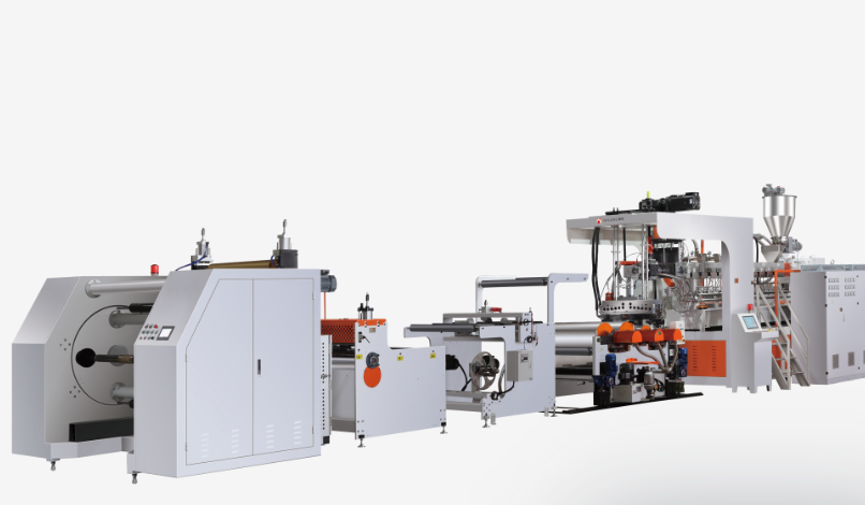
Compared with PP, PE and other general plastics, typical biodegradable material such as PLA, PBAT and starch blends has obvious processing limitations. Its thermal stability window is narrow; overheating for 2–3 minutes triggers molecular degradation, yellowing and brittle sheets. Meanwhile, poor fluidity under low temperature leads to incomplete melting, fish eyes and uneven thickness. These unique traits raise requirements for every link in the extrusion process, and minor parameter deviations will directly push scrap rates and power consumption upward.
A complete sheet production workflow centered on biodegradable equipment follows four core steps: raw material drying, screw melting and homogenization, T-die extrusion and three-roll calendering, constant-tension winding. Every stage’s parameter setting interacts closely with running costs. A well-calibrated plastic sheet extrusion machine can lower reject rates by 60%, while unoptimized equipment will generate repeated waste and extra energy loss throughout the whole sheet extrusion line.
All daily expenditure items for biodegradable sheet production are sorted clearly in the table below:
| Cost Category | Specific Content | Proportion of Daily Expense |
| Raw material cost | Virgin PLA/PBAT, calcium carbonate filler, recycled edge trim | 55%–65% |
| Energy cost | Barrel heating, motor operation, cooling water circulation, vacuum pump | 18%–25% |
| Maintenance cost | Screw cleaning, filter screen replacement, roller calibration, spare parts | 6%–10% |
| Labor & downtime cost | Debugging labor, loss from unexpected machine halt | 7%–12% |
Among all expenditure items, raw material and energy occupy over 75% of total daily outlay, which are the core breakthrough points for cost reduction. Maintenance and downtime losses are hidden long-term expenses easily overlooked by operators; worn screw flights or uninsulated barrel sections will continuously increase power and material waste. All cost control measures must adhere to one core principle: reduce running expense while keeping biodegradable extrusion quality.
Any cost-reduction adjustment cannot damage standard extrusion quality of finished sheets, including uniform wall thickness, transparent surface, stable tensile strength and full biodegradability. Three non-negotiable control standards guide all optimization work:
Scrap rate shall not exceed 3% after optimization, avoiding secondary waste from unqualified products
Material blending ratio must comply with national biodegradable certification standards, without excessive cheap filler that damages product performance
Melt temperature and residence time must stay within safe processing ranges to prevent material degradation
Improving material compatibility is the most direct way to reduce raw material expenditure without hurting sheet performance. Pure PLA carries high purchase costs, while reasonable blending with PBAT, starch and food-grade calcium carbonate can cut unit material cost by 12%–18%. Matching rules vary by product type: rigid packaging sheets adopt 60% PLA + 30% PBAT + 10% calcium carbonate; ultra-thin flexible blister sheets increase PBAT proportion to enhance ductility and reduce breakage during forming. Compatible blends also reduce screw shear pressure, indirectly lowering motor power consumption.
Two practical material selection strategies cut daily consumption:
These material management methods constitute core paths to realize cost optimization for daily plastic sheet extrusion with biodegradable material.
Targeted daily operation adjustments deliver immediate cost savings for biodegradable extruders:
Short-term parameter tuning only achieves temporary savings; stable profit improvement relies on systematic long term cost saving tips for biodegradable sheet extrusion line:
Upgrade low-shear customized screw elements to reduce material degradation and lower scrap rate fundamentally
Equip online thickness detection sensors to alarm abnormal sheet deviation instantly, stopping mass defective production
Build standardized maintenance schedules to extend screw, roller and heating tube service life, cutting annual spare parts purchase costs
Deploy waste heat recovery systems to reuse barrel cooling heat for raw material pre-drying, forming closed energy circulation
Coordinated optimization of material formula and equipment parameters further amplifies cost reduction effects. When adjusting blending ratios, synchronously tweak screw temperature zones and vacuum negative pressure: high-filler formulas need slightly elevated melting temperature and enhanced vacuum devolatilization to eliminate pinholes; high-PBAT flexible sheets reduce shear intensity to avoid over-stretching and thickness inconsistency. Synchronized tuning of formula and equipment minimizes repeated trial production waste and shortens line debugging cycles, greatly lifting overall equipment efficiency of the whole production line.
Can we add excessive calcium carbonate filler to biodegradable materials to cut raw material costs drastically?
Excessive filler will destroy sheet tensile and transparency, leading to high scrap rates during downstream thermoforming; blending proportion must be controlled within the range that guarantees product performance.
Will reducing extruder idle temperature cause frequent die blockage and raise downtime costs?
Reasonable temperature reduction matched with low screw idle speed can balance energy saving and smooth melt flow, as long as operators record stable idle parameter archives for different biodegradable pellets.
Where can factories obtain integrated formula matching and energy-saving equipment debugging support for biodegradable sheet production?
WYLONG provides customized screw configuration, formula optimization and full-line energy-saving transformation services for all types of biodegradable sheet extrusion equipment.
Sustainable sheet manufacturing centered on biodegradable extruders faces persistent pressure from high raw material and energy costs, and long-term profit stability cannot rely on single temporary cost-cutting means. This article systematically sorts four major daily expenditure categories of biodegradable sheet production, interprets core logic including reduce running expense while keeping biodegradable extrusion quality, and shares layered solutions covering material compatibility matching, daily operation tuning, full-line long-term transformation and standardized maintenance.
From raw material closed-loop recycling and rational filler blending to barrel energy-saving transformation and low-shear screw customization, every optimization link targets the unique thermal sensitivity and high cost of biodegradable resin, helping manufacturers cut comprehensive daily running costs by 15%–22% while maintaining stable sheet surface finish and mechanical performance. WYLONG integrates mature energy-saving and low-waste extrusion technology into its biodegradable equipment solutions for packaging factories of all sizes.
If your sheet production line struggles with high daily power consumption, excessive biodegradable material scrap or unstable formula matching costs, and you need customized equipment parameter optimization, material blending guidance or full-line cost-saving transformation plans, contact our professional technical team to obtain exclusive long-term cost control schemes tailored to your biodegradable sheet extrusion specifications.

Our professional team of technical experts provides services for your needs around the clock time.

 Optimized by Seraphinite Accelerator